Police Robinson v Chief Constable of West Yorkshire (Court of Appeal) Clyde & Co
Police liability in negligence positively narrowed. In Robinson v Chief Constable of West Yorkshire Police [2018] UKSC 4, the Supreme Court made significant inroads into the principle that the police cannot be sued in negligence save in exceptional circumstances as a result of alleged failures in their core operational duties. Now, where a.
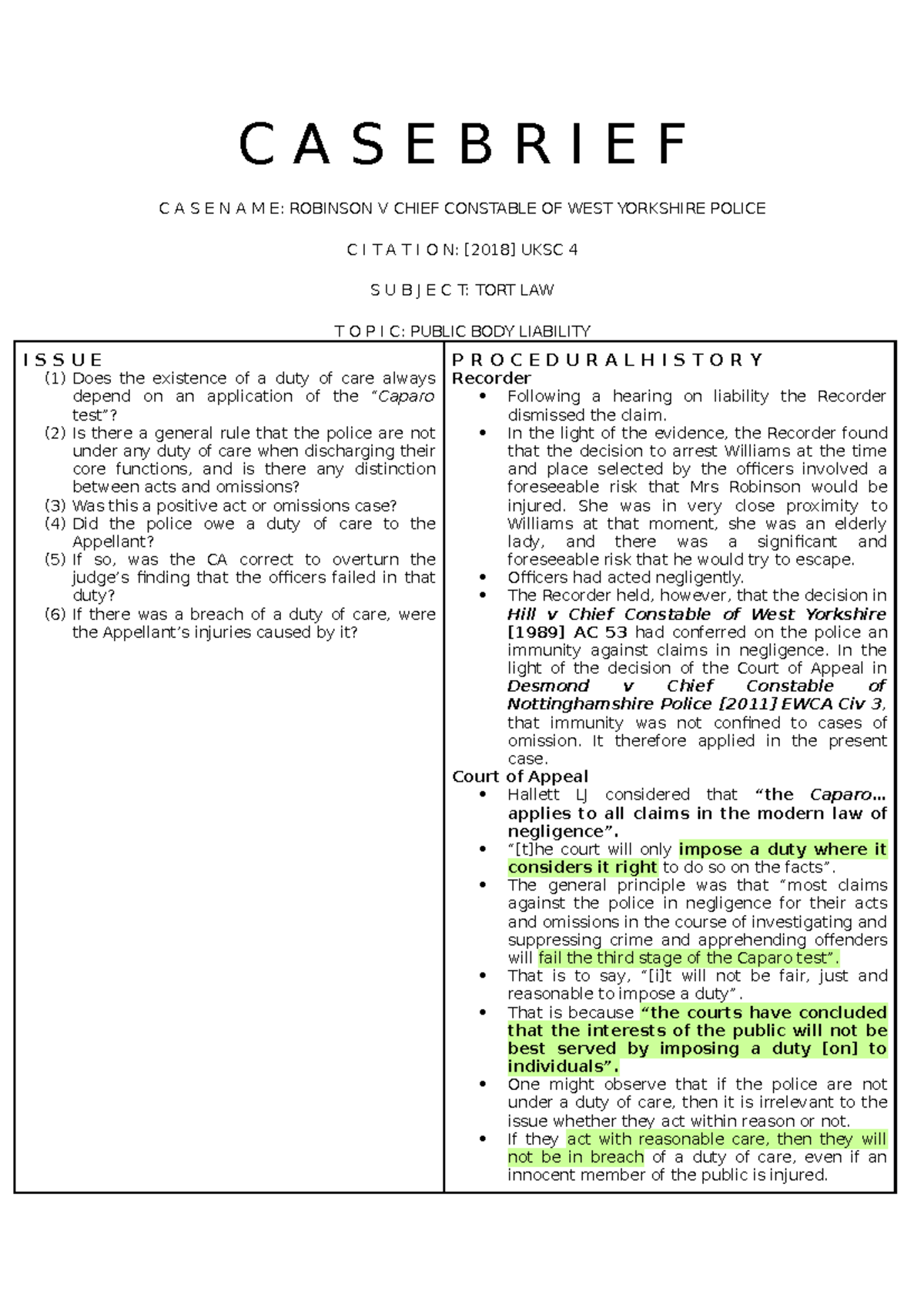
Robinson V Chief Constable OF WEST Yorkshire Police C A S E B R I E F C A S E N A M E
In Robinson v Chief Constable of West Yorkshire Police [2018] UKSC 4; [2018] 2 WLR 595 this court recently held, with regard to this aspect of Caparo, that it is. English test in Caparo . 69 The fallout of Anns is discussed by Lord Reed at [23] in Robinson v Chief Constable of West Yorkshire Police [2018] UKSC 4. 88 [Vol 28, 2021] of Anns.
Chief Constable of West Yorkshire Police apologises for 'language and terminology' used about

In 2018, the United Kingdom Supreme Court delivered its judgment in Robinson v. Chief Constable of West Yorkshire Police, in which a plurality strikingly rejected as misconceived attempts to identify such a general test. Duty cases, the Supreme Court held, are to be decided by reference to precedent where applicable, or (where no such precedent.
Robinson v Chief Constable of West Yorkshire Robinson v Chief Constable of West Yorkshire
The police officers were liable for negligence; The liability of the police is based on ordinary principles of negligence, as such no special immunity applies to them; There was a positive act by the police injuring C, the risk of injury of passersby was foreseeable and there was a breach of duty: Lord Reed at [73] Lord Reed. Anns test is.
From the FBI to York’s top cop five things you should know about the new Chief Constable YorkMix

three-fold test. police officers. Robinson v Chief Constable of West Yorkshire Police [2018] UKSC 4 is a leading English tort law case on the test for finding a duty of care. An elderly woman was injured by two police officers attempting to arrest a suspect and she claimed that the police owed her a duty of care not to be put in danger. [1]
North Yorkshire Chief Constable announces retirement BBC News

Claimant: Mrs Robinson a 76-year-old frail woman Defendant: West Yorkshire Police (on behalf of the actions of their officers) Facts: Mrs Robinson suffered injuries when she was knocked over and fallen on by two Police Officers who were physically apprehending a suspected drug dealer whilst she was in close physical proximity. Both the trial.
Robinson v Chief Constable of West Yorkshire (2018) Case Summary and Legal Principles

In 2018, the United Kingdom Supreme Court delivered its judgment in Robinson v. Chief Constable of West Yorkshire Police, in which a plurality strikingly rejected as misconceived attempts to identify such a general test.. "Robinson v. Chief Constable of West Yorkshire Police." Journal of Tort Law, vol. 16, no. 1, De Gruyter, 2023, pp.
The Duty of Care After *Robinson v Chief Constable of West Yorkshire Police* Professor Donal

The Duty of Care After Robinson v Chief Constable of West Yorkshire Police Daniel Clarry (ed), The UK Supreme Court Yearbook, Volume 9: 2017-2018 Legal Year (Appellate Press, 2019) 174-205 Oxford Legal Studies Research Paper No. 49/2019
West Yorkshire Police's new chief constable confirmed BBC News

Supreme Court') in Robinson v Chief Constable of West Yorkshire Police ('Robinson'),1 where Lord Reed gave a leading judgment that represents a golden opportunity to * Professor of Private Law, University of Oxford; Francis Reynolds and Clarendon Fellow and Tutor in Law, Worcester College, Oxford. 1 [2018] UKSC 4, [2018] AC 736.
West Yorkshire Police Congratulated for ‘Excellent’ Performance Chief Constable John Robins

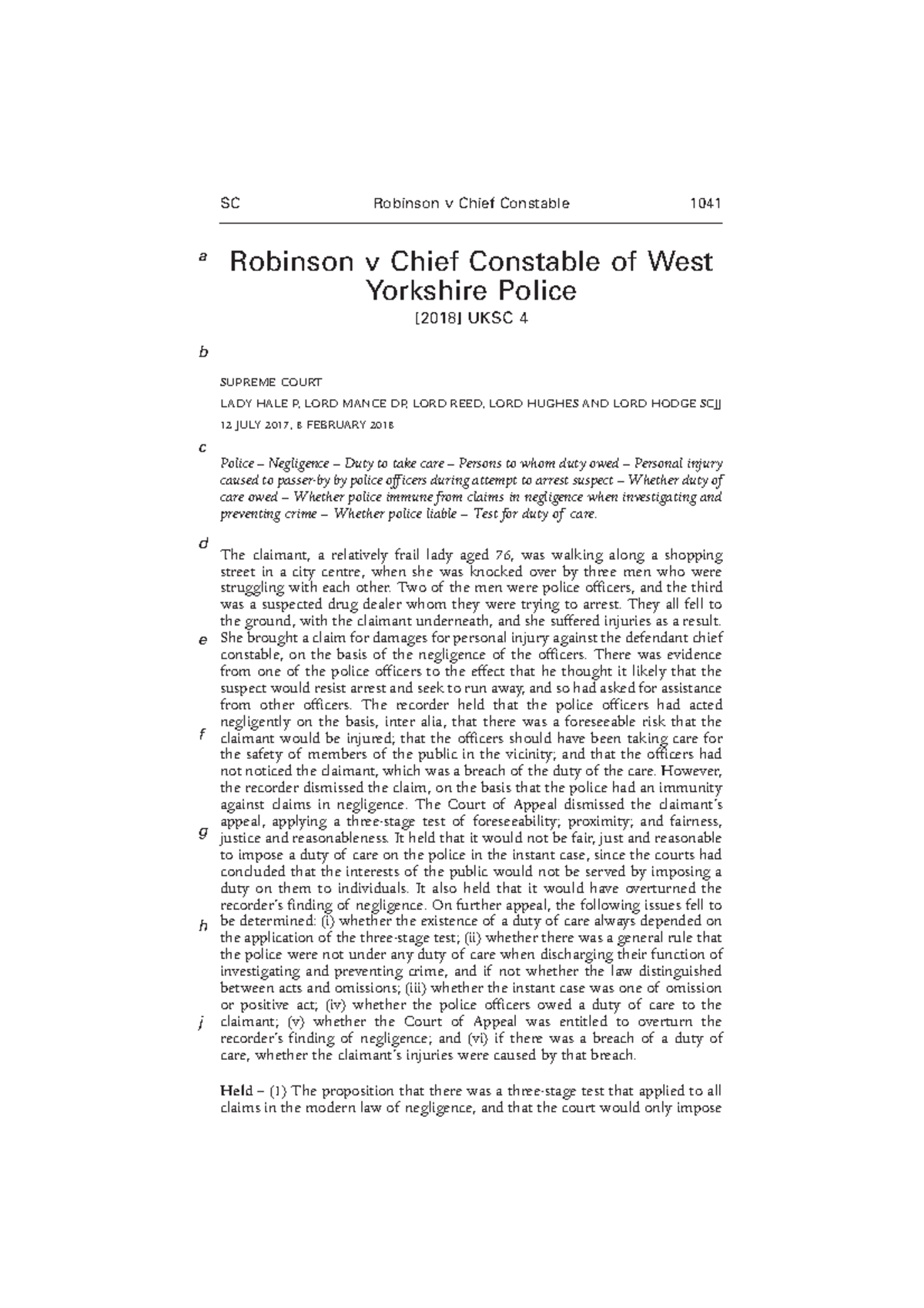
Robinson v Chief Constable of West Yorkshire Police [2018] 2 WLR 595 Supreme Court. The claimant was a 76 year old woman who sustained injuries when she was knocked to the ground by a drug dealer in his escape from arrest. Two police officers who were trying to carryout the arrest fell on to the claimant when she was on the ground.
West Yorkshire Police chief constable in favour of positive discrimination to recruit more BAME

FACTS. Detective Sergeant Willan and Police Constable Dhurmea, (Two Police Officers) attempted to arrest a suspected drug dealer on a weekday afternoon in a shopping street in a town centre. A struggle ensued, leading to a collision that involved the three men and Elizabeth Robinson (The Claimant), a relatively frail 76-year-old elderly lady.
Tort 11 Lecture notes 11 Robinson v Chief Constable of West Yorkshire Police [2018] UKSC 4
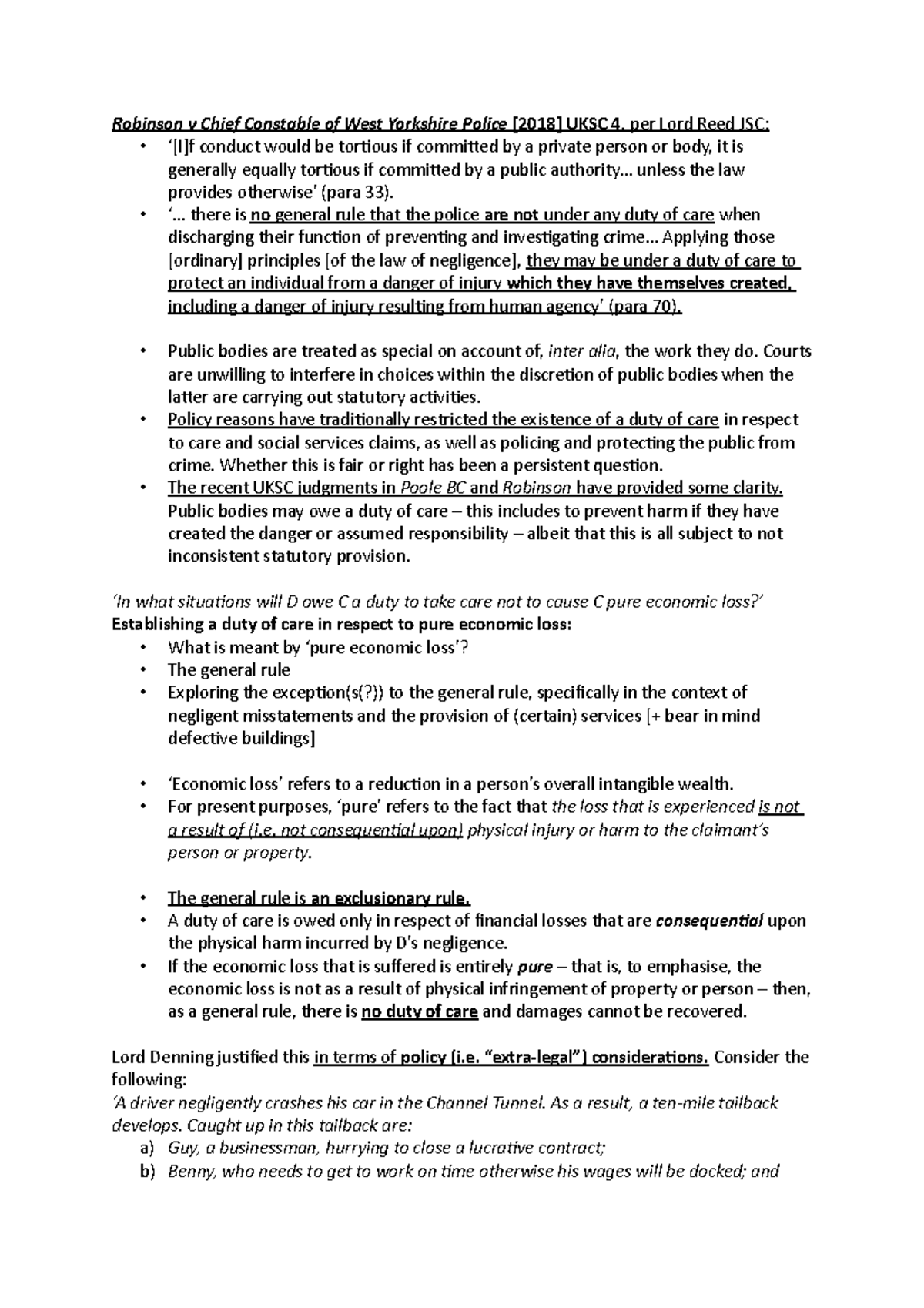
Chief Constable of West Yorkshire, indicates that the private duties owed in tort by public entities are the same as any other party under the common law. Robinson involved a positive act by police which harmed an innocent bystander; the UKSC was unanimous that the police owed a private duty of care to the victim.
Robinson v Chief Constable of Yorkshire [2018] 2 WLR 595 www.elawresources.co.uk

In 2018, the United Kingdom Supreme Court delivered its judgment in Robinson v. Chief Constable of West Yorkshire Police, in which a plurality strikingly rejected as misconceived attempts to identify such a general test. Duty cases, the Supreme Court held, are to be decided by reference to precedent where applicable, or (where no such precedent.
ROBINSON V CHIEF CONSTABLE OF WEST YORKSHIRE

Material Facts in Robinson v Chief Constable of West Yorkshire. The case involved two police officers attempting to arrest a suspected drug dealer on a busy street. During the arrest, a struggle ensued, and the officers, along with the suspect, knocked into Elizabeth Robinson, a 76-year-old passerby. Mrs. Robinson was injured as a result.
Robinson v Chief Constable of West Yorkshire CN v Poole Borough Council [2017] EWCA Civ 2185

The Supreme Court of the United Kingdom Parliament Square London SW1P 3BD T: 020 7960 1886/1887 F: 020 7960 1901 www.supremecourt.uk 8 February 2018 PRESS SUMMARY Robinson (Appellant) v Chief Constable of West Yorkshire Police (Respondent)[2018] UKSC 4
A closer look at Robinson v Chief Constable of West Yorkshire Police The Student Lawyer

In 2018, the United Kingdom Supreme Court delivered its judgment in Robinson v. Chief Constable of West Yorkshire Police, in which a plurality strikingly rejected as misconceived attempts to identify such a general test. Duty cases, the Supreme Court held, are to be decided by reference to precedent where applicable, or (where no such precedent.